
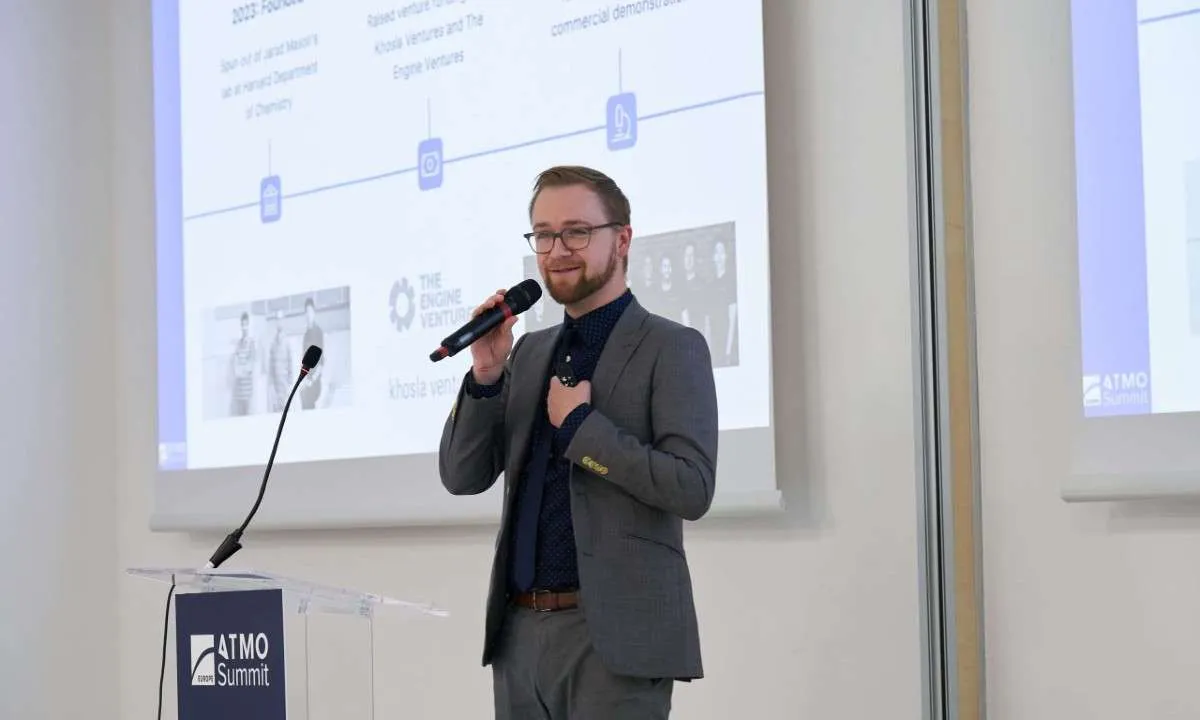
Adam Slavney, CEO and Co-Founder of U.S.-based startup Pascal, outlined the potential of the company’s low-pressure solid-state barocaloric refrigeration design at the ATMOsphere (ATMO) Europe Summit 2025.
In a presentation, Slavney shared details about the technology, costs and efficiency. The event, organized by ATMOSphere, was held November 24–25 in Padua, Italy. ATMOsphere is the publisher of NaturalRefrigerants.com.
“When the solid undergoes a phase transition between ordered and disordered states under applied pressure, there is a very large change in entropy,” Slavney said. “It absorbs or releases heat, with Pascal’s materials producing a temperature change of more than 30°C [54°F] in a single pressurization stage.”
The technology: The system cycles through pressurizing two thin–tubed heat exchangers packed with Pascal’s solid powder material, with one heat exchanger hot at any given time and the other cold.
- “We use a gas compressor, preferably a CO2 one, to apply up to 20bar [290psi] pressure to the solid refrigerant material,” Slavney said, with the on/off cycle lasting from as few as 30 seconds up to several minutes. “We’ve observed a temperature range from −10 to 50°C [14 to 122°F] on the surface of the tube,” he added.
- For refrigeration, a secondary heat transfer fluid circulates to absorb heat from the barocaloric solid, transferring it to the ambient air and carrying cooling to the refrigerated space.
- The startup, founded in 2023 as a spin–out of a Harvard chemistry lab, raised venture funding to develop the technology from Khosla Ventures and The Engine Ventures.
Costs/efficiency: “We can build the system using roughly 80% off-the-shelf components,” Slavney said, which supports cost parity with existing refrigeration technology.
- The company needs a CO2 compressor capable of operating at 10‒20bar (145‒290psi) and a thin-walled heat exchanger to increase efficiency, according to Slavney. “If you produce compressors or heat exchangers and are interested in pushing the envelope, I want to talk to you,” he added.
- He compared Pascal’s solid refrigerant system to a propane (R290) gas compression system. Every mole of propane produces 14kJ of energy per cycle, while sending a mole of CO2 over a similar pressure range produces 26kJ of energy per cycle in the solid–state system.
- However, Pascal’s system incurs additional losses, including heating and cooling of the heat exchangers. “We think we will net out ahead,” Slavney said. “By the end of 2026, we hope to demonstrate a 20% energy efficiency improvement over a state-of-the-art compression system.”
Product development: Pascal has built an integrated barocaloric benchtop system capable of 0.03–0.04kW (.009‒.01TR) of cooling power using air as the secondary heat-transfer fluid, according to Slaveny. In approximately 90 minutes, it lowers the ambient temperature to a 3°C (37°F) refrigeration temperature.
- The company planned to move the benchtop into a commercial demonstration with controlled insulation boundaries by the end of 2025.
- Although its customers are driving commercial development, Slavney noted, larger applications, such as commercial HVAC, would provide better economies of scale in terms of efficiency.
Quotable: “Traditionally, calorics have suffered from very high operating pressures, which leads to thick metal walls and expensive components,” Slavney said. “Pascal was founded on driving down the pressure, and now our systems operate in a conventional HVAC range.”
“Pascal’s materials produce a temperature change of more than 30°C [54°F] in a single pressurization stage.”
Adam Slavney, CEO and Co-Founder of Pascal

.JPG)